Glass Joint Sizes Explained : 10mm, 14mm and 18mm
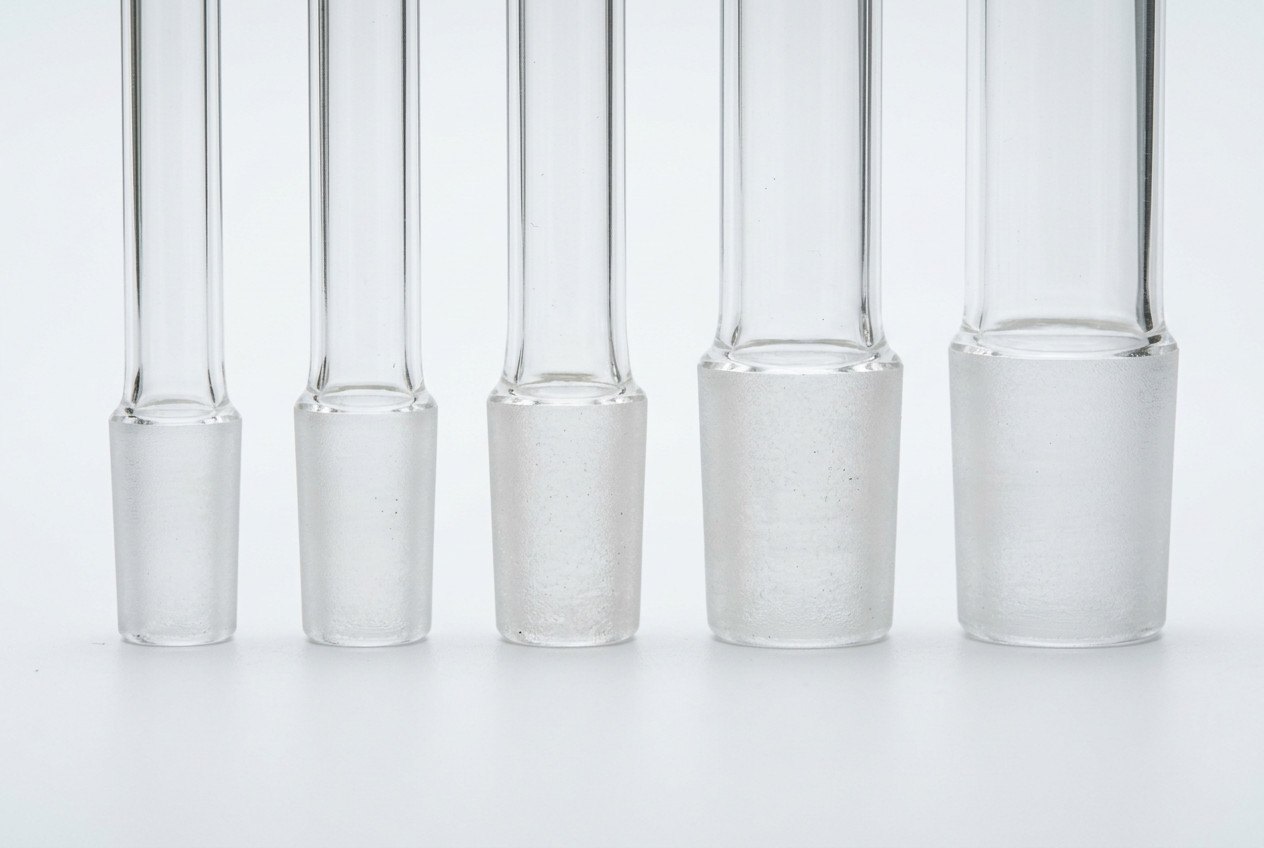
Ground glass joints follow a standard originally set for laboratory apparatus, which is why consumer glassware sizes look oddly specific. The figure quoted — 10mm, 14mm or 18mm — is the outer diameter at the widest point of the tapered section, not the length of the joint or the bore of the tube.
Measuring accurately
Place calipers across the widest part of the frosted taper. The three common sizes are close enough that eyeballing them is unreliable: 14mm and 18mm differ by less than the thickness of a pencil. If calipers are unavailable, the nominal figures are 10mm ≈ 0.39in, 14mm ≈ 0.55in and 18mm ≈ 0.71in.
| Nominal size | Outer diameter | Typical use |
|---|---|---|
| 10mm | 10.0 mm | Compact pieces, concentrate-focused hardware |
| 14mm | 14.5 mm | The most common general-purpose size |
| 18mm | 18.8 mm | Larger pieces, higher airflow volume |
The measured diameters run slightly above the nominal figure because the standard specifies the diameter at the top of the ground section. This is why a piece may measure 14.5mm and still be a 14mm joint.
Male and female
Every joint is one or the other. The female joint is the receiving socket, frosted on its inner surface; the male joint is the inserted taper, frosted on its outer surface. Two joints of the same nominal size will only mate if one is male and one is female — a fact that sounds obvious but accounts for a good share of mail-order disappointment.
Adapters
Adapters exist for essentially every combination: size up, size down, and gender change. They are inexpensive and solve compatibility problems without replacing hardware. The trade-off is that each additional joint is another potential leak point and another surface to clean, so the tidiest configuration is still matched components where that is practical.
Fit note: a correctly matched ground joint holds by friction alone and needs no grease, clip or tape. If a joint will not seat, or seats but rocks, the sizes do not match — forcing it risks chipping the taper.
Caring for the ground surface
The frosted section is deliberately roughened, and that texture is what creates the seal. Residue accumulating in it will eventually prevent a clean fit, and — worse — can cause two pieces to seize together. A cotton swab with isopropyl through the socket after cleaning keeps the surface serviceable. If a joint does seize, gentle warmth applied to the outer socket expands it slightly and usually releases the taper; force and leverage break glass.

Marcus Reyne
Marcus Reyne spent nine years as a bench technician servicing laboratory borosilicate before turning to consumer glassware and vaporizer hardware. He writes about cleaning chemistry, thermal stress and hardware longevity.